
SAP ECC end of life: it’s not an IT deadline, it’s a decision about your digital core
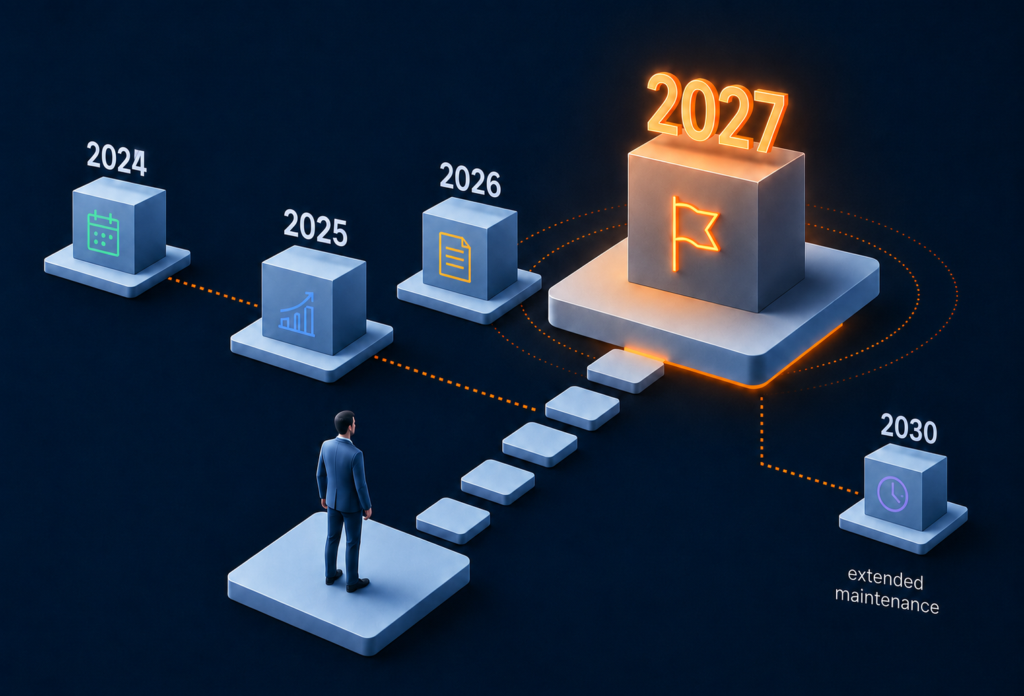
For most organizations, 2027 still feels a long way off. There’s always something more urgent competing for attention: quarterly targets, transformation programs, cloud migrations, daily operational demands. But for any organization still running SAP ECC, a real deadline is approaching: mainstream maintenance for SAP Business Suite 7, which includes SAP ERP 6.0 / ECC, ends at the close of 2027.
On paper, that sounds like a technical detail buried in a SAP roadmap. In reality, it cuts straight to the core of how a business runs. ECC underpins finance at a minimum, often procurement as well, and in the broadest sense finance, procurement, logistics, production, inventory, and HR, while also serving as a primary source system for reporting, compliance, and management information. Touch ECC, and you’re touching processes, data, decision making, risk, and how departments, business units, and external partners work together.
So the real question isn’t just “when do we move to SAP S/4HANA?” It’s “what kind of digital core does this organization actually need for the next decade?”
Beyond an upgrade: a strategic decision
SAP launched S/4HANA back in 2015 as the next generation of enterprise software, built on SAP HANA and positioned as the foundation for future digitalization. Plenty of organizations have already made the switch or are somewhere in the process, but a large group is still running on ECC.
That’s not surprising. ERP systems are rarely just software; they’re the accumulated result of years of process decisions, customizations, integrations, reports, individual exceptions, and organizational trade offs. That’s exactly why moving to S/4HANA isn’t a routine upgrade. It’s an opportunity to revisit fundamentals: which processes should be standardized, which customizations are actually still worth keeping, which data matters most for steering the business, compliance, and future AI use cases, and whether SAP even still fits where the organization’s digital architecture is headed.
That’s what makes the ECC deadline a matter for the boardroom, not just for IT, relevant to CIOs, CFOs, COOs, and executive teams alike. Not because every organization has to rush to S/4HANA, but because delaying the decision without a clear direction gets riskier by the day.
The pressure is building
SAP will support mainstream maintenance for SAP Business Suite 7 core applications through the end of 2027. After that, organizations can pay for optional extended maintenance through 2030, at a higher cost. Anyone still on ECC beyond that point is in an increasingly uncomfortable spot.
Gartner puts the number of SAP ECC customers at roughly 35,000 as of the end of 2024, with about 39% already migrated to S/4HANA or in the process of migrating. At the current pace, Gartner expects around 17,000 organizations to still be running ECC in 2027. SAPinsider’s 2025 benchmark paints a similar picture: 34% have already moved to S/4HANA, 41% plan to migrate before the end of 2027, 18% don’t expect to make that deadline, and 7% have no migration plans at all.
So lagging behind on ECC is common, but that doesn’t make it safe. The costs of standing still are becoming very real: rising maintenance fees, less access to new innovation, growing security and compliance exposure, a shrinking pool of ECC expertise, customizations that get harder to maintain, and integrations that increasingly clash with modern cloud and data environments. Migration capacity is shrinking too. The closer 2027 gets, the more competition there’ll be for specialists, implementation partners, architects, and internal project capacity.
Step one: decide whether SAP is even the future
There’s no single right answer here, it depends on the organization. But the first question to settle is more fundamental than any migration route: does this organization want to stay on SAP at all? Only once that’s answered does it make sense to talk about how. The right path depends on strategy, architecture, how mature your processes are, how much change the organization can absorb, and how central ERP is to the broader digital landscape.
Moving away from SAP. For some organizations, the ECC deadline is the natural trigger to ask whether SAP still fits where they’re headed. Walking away can open the door to redesigning processes and cutting dependencies. But the complexity involved doesn’t disappear, it just moves, typically into integration work, data migration, process harmonization, and managing organizational change.
For organizations that decide to stay on SAP, there are broadly three ways to get to S/4HANA:
- Greenfield: build the digital core from the ground up. Nothing gets carried over automatically; processes, configurations, and customizations are redesigned around the S/4HANA standard. So everything is independent of the existing ECC setup. This gives you the most room to simplify and standardize, but it also demands the most time, investment, and organizational change, and there’s a real risk of losing valuable knowledge and customization along the way.
- Lift and shift to S/4HANA. Here you start from what you already have. The existing ECC system gets converted to S/4HANA, keeping as much of the current processes, data, configuration, and customization intact as possible. It’s less disruptive and usually the faster route to technical compliance, but the trade off is that existing complexity comes along for the ride.
- Bluefield: reimplementation. This sits between the other two: keep what’s genuinely valuable, rebuild what isn’t. It strikes a balance between continuity and renewal, but it demands mature decision making, tight governance, and real ownership from the business side, not just IT.
Start with an independent impact analysis
At Anderson MacGyver, we approach questions like this through a business technology lens, not by starting with a preferred system, but by asking what digital setup the organization actually needs to deliver on its strategy. Applied to SAP ECC, that means starting with a decision framework, not a solution.
Map out exactly what role ERP plays in the strategy. Find out where the complexity, customization, and technical debt really sit. Identify which data is critical for steering the business, for compliance, and for future AI applications. Compare the available scenarios on cost, risk, organizational change capacity, and strategic value. And set up governance where business and IT make these calls together.
The ECC deadline creates real urgency, but urgency shouldn’t turn into tunnel vision. For some organizations, S/4HANA genuinely is the logical next step. For others, this is the moment to rethink the ERP landscape more broadly. A temporary extension can be a defensible choice too, as long as it’s a deliberate part of a roadmap rather than an excuse to put off the decision.
Either way, one thing holds true across the board: it’s no longer a decision organizations can afford to leave open ended. The ECC deadline isn’t an IT deadline, it’s a deadline for making real strategic choices about the organization’s digital backbone.
These aren’t decisions we make in the abstract: Anderson MacGyver helps organizations across sectors such as Education & Research (Leiden University & Tilburg University), Non-profit (Oxfam Novib), Construction and Infrastructure, Manufacturing, and Hospitality work through exactly this challenge.
Already have a sense of which route fits your organization? Get in touch to talk through your specific situation.