

Culture eats performance for breakfast
She was the best planner on the team. Give her a process, a deadline, and a clear goal, and she delivered every time. Then the team got restructured and got an added expectation to spend a fair share of their time on innovation: loose scope, fast iteration, figure it out as you go. Within a month, her manager quietly wondered if she’d lost her edge.
She hadn’t. Her team was now doing two very different kinds of work, but nothing had changed in the way they were managed, measured, or led. The problem wasn’t her. It was the mismatch.
The real cause
We have seen this more than once in organizations, and it’s rarely diagnosed correctly. When someone underperforms after a change in team or scope, we tend to look at skills, effort, or motivation first. Often, the real issue is culture: the team runs on a different set of values and a different leadership style than that type of work actually needs. A different approach to leadership, governance and way of working can be the answer to close the gap.
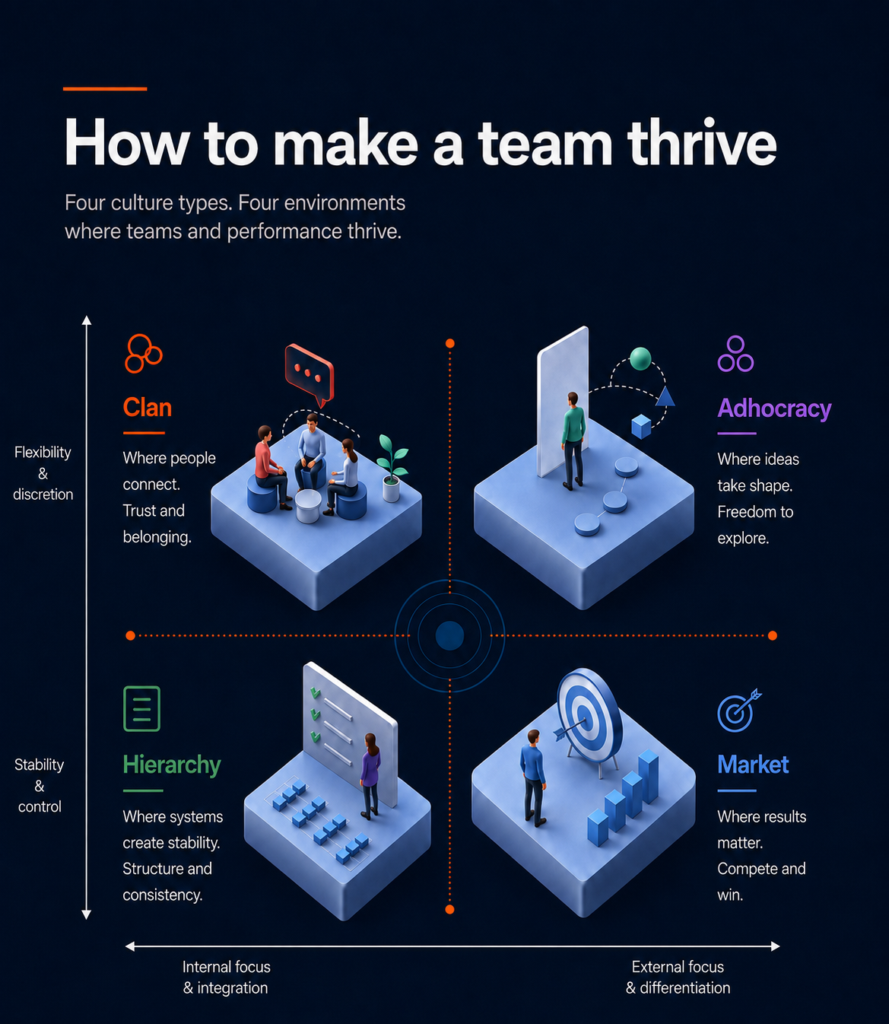
Kim Cameron and Robert Quinn’s Competing Values Framework (2006) explains why. It maps organizational culture along two questions: does the team value flexibility or control, and is its focus internal or external? Together, these produce four distinct culture types, each with its own leadership style, its own definition of success, and its own kind of team who thrives in it.
No type is better than the other. The mistake isn’t picking the wrong culture. It’s assuming one culture, applied uniformly, can carry every kind of work an organization does. It can’t. Stable, repeatable activities need a different culture and leadership style than fast-moving, ambiguous ones.
How to make a team thrive
Adhocracy: this team’s work is about responding to change, new products, new customer expectations, new developments in technology or competition. It thrives on room to experiment and fast iteration.
Clan: this team’s work depends on deep, specific expertise, applying specialized knowledge to complex, well-defined problems. It thrives on trust and closeness between its members, working together toward a shared goal.
Market: this team adapts quickly to customer demand and technology, carrying out activities comparable to other organizations. It thrives on a clear target and being measured against a result, since speed and responsiveness are the priority here.
Hierarchy: this team’s work is stable and repeatable, delivering a good, reliable product or service at the right price. It thrives on consistency, doing the same thing reliably every time.
Back to our planner
Our planner wasn’t failing. An organizational change had placed a new expectation on her team: alongside their existing work, they now also had to spend time on innovation. Asking both from the same team created a tension that could be felt in the governance, way of working and culture. Ideally, stability and innovation are organized in different places in the organization, so each can genuinely flourish.
You may see underperformance or tension at the individual level, but that’s not where it lives. It’s a team issue: one organization needs room for more than one culture, with each team culture matched to the kind of work it does.