
Digital sovereignty requires a multimodal organization
Discussions on digital sovereignty are often centered around technology choices. Which cloud platform do we use? Where is our data stored? Which partners do we depend on? Technology choices matter, especially in a world where geopolitical tension, concentrated platform markets and new regulations have made it more likely that dependencies influence business continuity. However, technology is only one part of the story.
Digital sovereignty is about being in control
The right technology does not automatically give an organization the desired level of control. You can select a sovereign cloud solution and still be fully dependent on external expertise. You can own the data and still lack the internal capability to govern, interpret or move it. Therefore, digital sovereignty is not only a technology issue, it’s an organizational issue.
Game-changing questions are: who carries out the work? Who is accountable? Who makes the decisions? How is decision-making organized? Who is able to challenge suppliers, assess alternatives and decide whether a dependency is still acceptable?
These questions determine whether an organization is truly in control. And the answer is not the same for every business domain. The dynamics and specificity of the activities guide organizational choices. That’s what we call the multimodal organization.
Start with understanding what truly matters
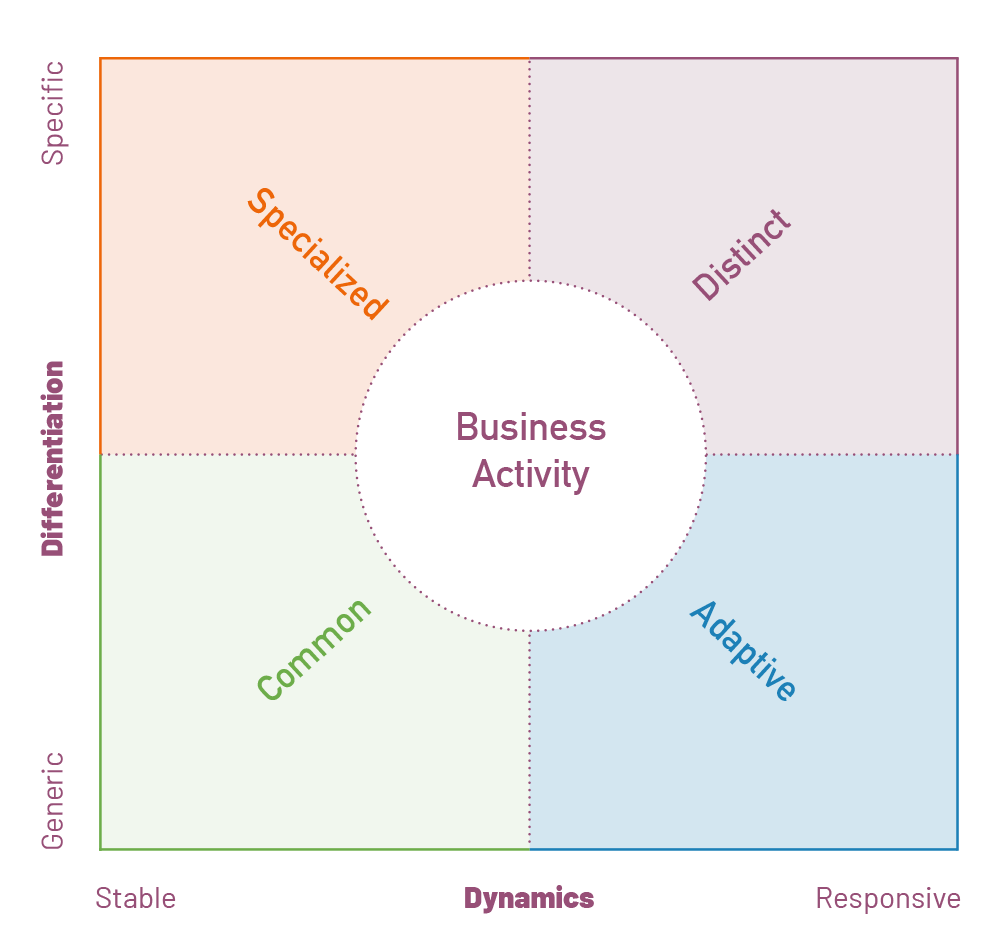
Digital sovereignty starts with strategic analysis. Which activities are specific to your organization? Where is your competitive advantage created? What activities include critical knowledge about customers, assets, processes or data? And where would loss of control create serious strategic, operational or regulatory risk?
These activities require a higher level of control. This does not mean that everything must be done internally. Digital sovereignty is not about pursuing full independence, but about making deliberate choices on ownership, accountability and decision-making power.
Specific activities: build the capabilities to govern what matters
For specific activities, ownership should be in-house or very close to the business. Also for strategically important activities, external partners can still play a valuable role. Co-creation with partners can bring speed, expertise and innovation. But ownership of intellectual property, and key choices about data, architecture and technology choices should not be left implicit or in the hands of suppliers. The organization must be able to steer, challenge, continue and, if needed, change direction.
For those crucial activities, it is important to understand the current level of dependency. Which technology is used? Who understands the solution internally? Who owns the architecture? Can the organization switch supplier, move technology or continue operations if the current partner is no longer available?
A practical way to make this concrete is to draw alternative scenarios. What would an exit scenario look like for a critical supplier? What would it take to migrate data and processes? Which capabilities and governance measures are needed to reduce dependency? These scenarios do not always lead to radical change. Sometimes the conclusion is that the dependency is acceptable, as long as governance is strengthened. Sometimes the right answer is to build more in-house orchestration capabilities.
Organizations need people who can connect business priorities, technology choices, data requirements, supplier performance and risk considerations. They need architects, product owners, vendor managers, data specialists and business owners who understand enough to make informed decisions together. Without these capabilities, sovereignty remains an ambition rather than an organizational reality.
Generic activities: benefit from the market without blind dependency
For generic activities, the logic is slightly different. These are activities where the organization benefits from external knowledge, market development and industry best practices. Partners can bring innovation, benchmarks and specialized expertise. But also in this case, dependency should be consciously designed through deliberate choices about data, technology, sourcing and governance.
For generic and stable activities, partner execution is often the most logical choice. These activities typically benefit from standardization, predictability and cost efficiency. The organization needs reliable execution, clear service levels and efficient operations. Exit clauses, control measures, data ownership, audit rights and continuity arrangements become important instruments to stay in control.
For generic and dynamic activities, organizations should work with partners that bring best practice and industry knowledge. These partners can help the organization innovate, benchmark and continuously improve without having to build all (execution) expertise in-house. The organization needs to focus on value while remaining in control through clear decision-rights, joint value steering, transparency in performance and exit clauses.
Multimodal organization: in control where it counts
Digital sovereignty is often framed as a question of independence. But for most organizations, full independence is neither realistic nor desirable. Dependency is unavoidable. The real question is whether dependency is conscious.
A multimodal organization helps answer that question. It creates a structured way to decide where control must be high, where partners can take the lead, where co-creation is needed and what activities call for market standards. It makes digital sovereignty specific to the point of organizational design, sourcing choices, capabilities and governance.
Conscious choices are key
Digital sovereignty is about conscious dependency, not full independence. Make deliberate choices for your organization. Stay in control where it matters.
In need of a sparring partner?
Call our experts:

Jeroen Spit
Practice Lead Organization & Sourcing